RunDot vs Runna: Why True AI Beats Template Training Every Time
If you're serious about getting faster while staying healthy, your training platform choice matters more than you think. While both RunDot and Runna promise to improve your running, they represent fundamentally different approaches to endurance training - and the results speak for themselves.
By the RunDot team at Predictive Fitness. Updated .
RunDot builds and adapts your running plan from your own data, using AI trained on over 20 years of real athlete data. Runna assigns a template plan based on a few questions. RunDot also adjusts for heat, humidity and elevation, plans for multiple races at once, scores your workout execution and predicts race-day pacing.
RunDot vs Runna at a glance
| Feature | RunDot™ | Runna |
|---|---|---|
| Foundation | Proprietary AI trained on 20+ years of real athlete training and performance data | Template plans based on a training "philosophy" |
| Starting assessment | Performance baseline, Training Stress Profile and optional genome analysis | Days per week, weeks until your race and approximate fitness |
| Heat, humidity and elevation | Adjusts training intensities before each workout | Same paces whether it's 60°F or 95°F with humidity |
| Multiple races | One cohesive program for every race you have planned | One single-race template at a time |
| Workout feedback | TrainX® scores for execution quality plus residual fatigue by stress type | Workouts and distance planned vs completed this week |
| Race-day pacing | RaceX® predicts target paces and splits for your course and conditions | No predicted times or condition-based pacing targets |
| Learns from results | Algorithms continuously improve based on real-world results | Static templates |
RunDot starts at $14.99/month or $156/year. 2 weeks free. No card required. Works with Garmin, Apple Watch, COROS and more.

The Foundation: True AI vs Template Automation
The difference between RunDot and Runna starts at the foundation - and it's not even close.
RunDot
Built on a proprietary AI model trained on over 20 years of real athlete training and performance data. This isn't repurposed technology or generic algorithms - it's purpose-built intelligence designed specifically for endurance training optimization.
Runna
Generates template training plans based on someone's training "philosophy." Every athlete of similar ability gets cookie-cutter plans based on just a few variables: their general ability level, how many days per week they want to run, and how many weeks until their event.
This foundational difference cascades through every aspect of your training experience. RunDot continuously learns and adapts; Runna delivers the same static plans regardless of your progress, setbacks, or changing circumstances.

Phase 1: Assessment - Knowing Where You Really Stand
RunDot: Comprehensive Individual Analysis
RunDot's assessment capabilities reveal your true training potential through multiple proprietary metrics:
Your DOT Score provides a 1-to-100 standardized scale of performance ability that:
- Normalizes for temperature, humidity, and elevation so you can evaluate performance improvement even if workouts are done in different conditions
- Adjusts for age and gender, giving you meaningful benchmarks
- Evaluates the significance of improvement at different performance levels, helping you set realistic improvement goals
Your Training Stress Profile quantifies your capacity to absorb different types of training stress (aerobic, threshold, muscular, neural) over various time periods, considering factors like:
- Age and body composition
- Gender and genetics
- Current performance level
- Historical training response
RunDot's Physiogenomix Technology can analyze your genome to determine your:
- Aerobic potential
- Trainability factors
- Recovery rate
- Injury predisposition
Runna: Basic Variables Only
Runna's "assessment" consists of asking:
- How many days per week do you want to run?
- How many weeks until your race?
- What's your approximate current fitness level?
That's it. No meaningful performance baseline, no individual capacity analysis, no environmental considerations, no physiological profiling.

Phase 2: Prescription - Getting the Right Training at the Right Time
RunDot: Intelligent, Adaptive Programming
RunDot prescribes training through sophisticated analysis:
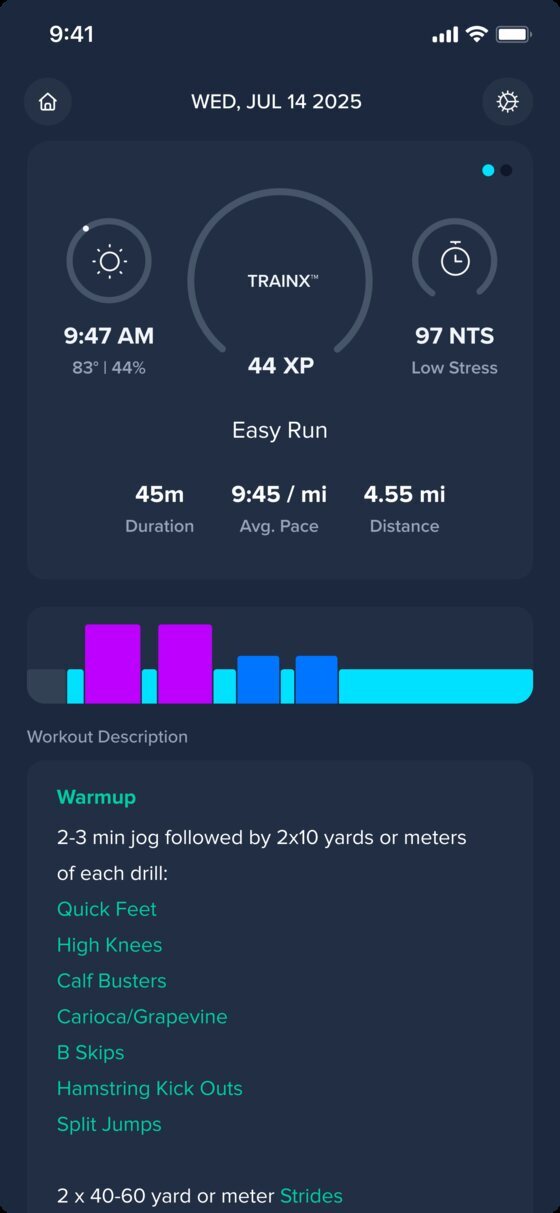
Normalized Training Stress (NTS) quantifies the exact training stimulus for each workout, distinguishing between different stress types (aerobic, threshold, muscular, neural) and prescribing the precise combination most beneficial for your current state.
Environment Normalization adjusts your training intensities before each workout based on:
- Temperature and humidity
- Elevation changes
- Indoor vs outdoor conditions
Proactive Planning considers your residual fatigue and recovery needs when scheduling future sessions, preventing overload before it happens.
Runna: Static Templates Regardless of Reality
Runna delivers the same template workouts to every similar athlete:
- Same paces whether it's 60°F or 95°F with humidity
- Same progression regardless of how you responded to previous training
- Same recovery assumptions for everyone
- No adjustment for your individual stress tolerance
RunDot: Cohesive Multi-Race Programming
RunDot prescribes the best training for you based on all of the races you have planned in the future. Each user's training program is custom designed for them and all the races they have planned, creating one cohesive program that intelligently prepares you for multiple events.
Runna: Single-Race Templates Only
Because Runna only offers training templates, users are only prepared for one race at a time. Each template is designed for a single event, forcing users to switch between disconnected plans.
If you're preparing for both a 5K in July and a marathon in September, Runna forces you to use the 5K template until July, then start the marathon template in August and September. This leaves you with very little time to increase training volume and long runs from 5K distance to those appropriate for a marathon.
With RunDot, you get one cohesive training program that prepares you for both the 5K in July and the marathon in September. Your training volume and long sessions leading up to the 5K consider not only the 5K performance but also that in just a couple of months, you'll need to be prepared for a marathon.

Phase 3: Evaluation - Understanding Your Training Response
RunDot: Comprehensive Progress Evaluation
RunDot evaluates your training through multiple sophisticated metrics:
TrainX Scores evaluate training execution for individual sessions and over time, replacing meaningless vanity metrics like total hours or distance with actionable feedback on training quality:
- Higher scores for completing prescribed distances on long runs
- Higher scores for nailing interval paces (not too fast, not too slow)
- Higher scores for keeping easy runs appropriately easy
Residual Training Stress (RTS) quantifies lingering fatigue by stress type, showing exactly how previous training affects your current state. This enables precise planning of future sessions and prevents the overtraining that derails so many runners.
Runna: Surface-Level "Insights"
Runna's "My Insights" section provides:
- Today's weather
- Workouts planned vs completed this week
- Distance planned vs completed this week
These aren't insights - they're basic data tracking with no analytical value for improving training effectiveness.

Phase 4: Prediction - Preparing for Race Day Success
RunDot: Precision Race Strategy
RunDot's prediction capabilities take the guesswork out of race day:
RaceX (Race Execution) predicts optimal target paces and race-day splits considering:
- Local terrain and elevation changes
- Expected temperature, humidity, and conditions
- Your current fitness and training adaptations
- Optimal pacing strategy for your physiology
Runna: No Predictive Capabilities
Runna does not offer predicted times or optimal pacing targets based on race-specific conditions, terrain, or your ability.
Perhaps most importantly, the ability to predict training and race outcomes is essential for measuring training effectiveness and improving it. RunDot is the only platform that can learn and improve its effectiveness and efficiency - its training algorithms are continuously improving based on real-world results.
Runna doesn't have the capacity to use training or race outcomes for self-improvement. It remains static, delivering the same template approaches regardless of whether they produce results.
What This Means for Your Training
The differences aren't just technical - they translate into real performance and health outcomes. When you're investing time and energy in something you love or pursuing an important goal, you need confidence that your training technology is the real deal and won't waste your effort or increase injury risk.
With RunDot You Get:
- Up to 30% more efficient training through precise stress management
- Fewer injuries from intelligent load progression and fatigue monitoring
- Better race results from truly personalized preparation
- More time for life outside running through optimized training
- Complete trust in your training program knowing it's backed by proven science
With Runna You Risk:
- Wasted training time from generic programming
- Plateaus and overtraining from inability to manage individual load
- Injuries from rigid progression that ignores your recovery needs
- Suboptimal race performance from one-size-fits-all preparation
- Uncertainty about whether your training approach will actually work
The Technology Behind the Results
RunDot's superiority stems from its proprietary AI foundation - 20+ years of athlete data powering algorithms designed specifically for endurance training optimization. This enables capabilities that template-based systems like Runna simply cannot match:
What RunDot Can Do (That Runna Cannot):
- Provide meaningful performance baselines and measure improvement significance
- Quantify training stress by type and manage it proactively
- Adjust training intensities for environmental conditions
- Evaluate training fatigue to manage recovery
- Prescribe training relative to age, gender, and individual capacity
- Predict training and race outcomes for continuous improvement
- Prepare you optimally for multiple races simultaneously
The Choice Is Clear

If you want training that treats you like an individual rather than a template, if you value efficiency over grinding out junk miles, and if you're serious about staying healthy while getting faster, the choice between RunDot and Runna isn't really a choice at all.
RunDot represents the future of endurance training - intelligent, adaptive, and proven effective. Runna represents the past - generic templates hoping one size fits all.
Your time is valuable. Your health matters. Your goals deserve better than guesswork.
Choose the platform that's actually built for your success: RunDot.
RunDot vs Runna: frequently asked questions
What is the difference between RunDot and Runna?
RunDot builds and adapts your training from your own data using a proprietary AI model trained on over 20 years of real athlete training and performance data. Runna generates template training plans based on a few variables: your general ability level, how many days per week you want to run, and how many weeks until your event.
Is RunDot better than Runna?
If you want training that treats you like an individual rather than a template, RunDot is built for that. It establishes your performance baseline, adjusts workouts for temperature, humidity and elevation, plans for every race on your calendar at once, scores how well you executed each session, and predicts race-day pacing. Runna delivers static template plans.
Does Runna adjust workouts for heat, humidity and elevation?
Runna delivers the same paces whether it is 60°F or 95°F with humidity. RunDot's Environment Normalization adjusts your training intensities before each workout based on temperature and humidity, elevation changes, and indoor vs outdoor conditions.
Can RunDot train me for more than one race at a time?
Yes. RunDot creates one cohesive training program for all the races you have planned. For example, if you have a 5K in July and a marathon in September, your training before the 5K also prepares you for the marathon. Runna templates are designed for a single event, so you switch between disconnected plans.
Does RunDot predict race times and pacing?
Yes. RaceX® (Race Execution) predicts optimal target paces and race-day splits considering local terrain and elevation, expected temperature and humidity, your current fitness, and the pacing strategy that suits your physiology. Runna does not offer predicted times or pacing targets based on race-specific conditions.
How does RunDot measure workout quality?
TrainX® Scores evaluate how well you executed each session as prescribed, such as completing long-run distances, nailing interval paces and keeping easy runs easy. Residual Training Stress tracks lingering fatigue by stress type so future sessions can be planned around it.
What does the Dot in RunDot stand for?
Data Optimized Training. RunDot uses your data, including your fitness, your workouts and the conditions you train in, to personalize your training every day instead of following a generic template.
How much does RunDot cost?
RunDot starts at $14.99 per month or $156 per year in the US. Every plan starts with a 2-week free trial, and no card is required.
Does RunDot work with my watch?
Yes. RunDot works with Garmin, Apple Watch, COROS and more.
Ready to experience training that's actually designed for you?
Start your RunDot journey today and discover what 30% more efficient training feels like.
Start your free trial2 weeks free. No card required.